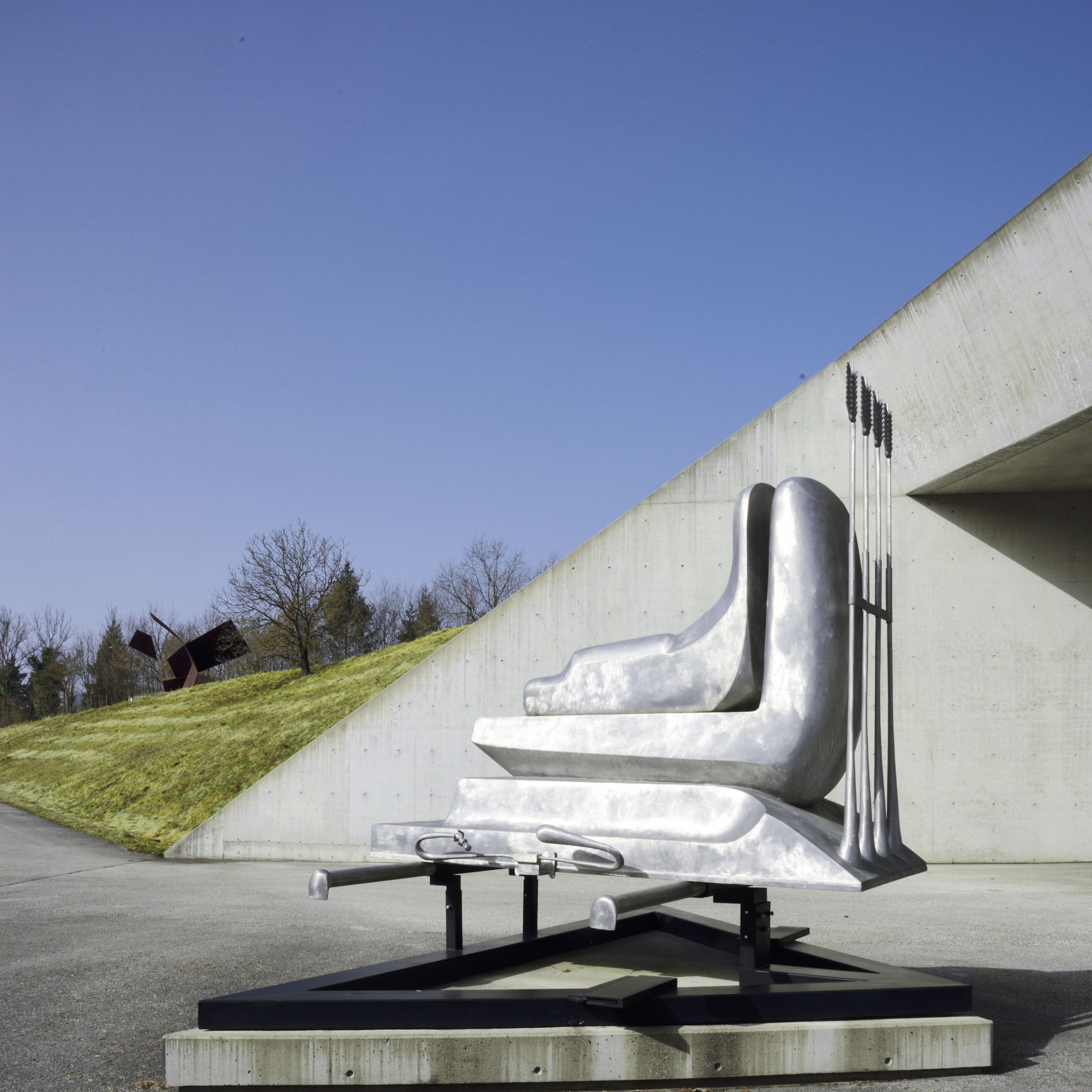
Bruno Gironcoli (1936, Villach–2010, Vienna)
Sarcophagus, 1977–1979/1986/2008
Cast aluminium, edition of 2
370 x 530 x 370 cm
Inv. No. 2257
On the meaning of the swastika symbols
The two swastika symbols on Bruno Gironcoli’s monumental sculpture often cause confusion. The artist explicitly emphasized that they are not intended to glorify National Socialism. The swastika was originally a symbol of good luck and protection dating back thousands of years, before it was appropriated by the Nazis.
The title "Sarcophagus" – sarkophágos means flesh-eater in Ancient Greek – alludes to death and can be interpreted as a reference to the fact that the inhuman and destructive ideology of National Socialism is to be laid to rest. At the same time, the embryonic figure on the side symbolizes rebirth / renaissance, whilst the ears of corn represent nourishment and life.
In this way, the artwork brings together opposites such as death and life, destruction and a new beginning.
The work "Sarkophagus" by the Carinthian artist Bruno Gironcoli, which has stood in front of the entrance to the Museum Liaunig since its opening in 2008, continues to cause confusion amongst visitors due to the symbolism and formal language employed by the artist. In particular, the two swastika symbols on this monumental sculpture from the artist’s later work raise questions.
Gironcoli explicitly points out that this is not a glorification of the Nazi regime, but draws attention to the fact that the swastika, as an Indo-European symbol (in Sanskrit "bringer of good fortune") was in fact an ancient symbol of good luck and protection, which the National Socialists appropriated and which is now inextricably linked to that ideology.
The title is "Sarcophagus" – "sarkophágos" means "flesh-eater" in Ancient Greek, and can be understood as a reference to the fact that the inhuman ideology of National Socialism is to be laid to rest.
In analytical psychology, following the tradition of Carl Gustav Jung, the sarcophagus is regarded as an expression of the threatening side of the so-called "mother archetype" – that is, the destructive and devouring mother. Throughout Gironcoli’s body of work, we repeatedly encounter his exploration of his troubled family history: his mother left the family when Bruno Gironcoli was 11 years old.
The basic form of the sculpture – a distinctly enclosed, stereometrically simple volume – is reminiscent of the "head sculptures" with which the artist began to experiment in the mid-1960s and which found their continuation in the "Murphy" series. The artist draws on Samuel Beckett’s protagonist Murphy, a symbol of the anti-hero whose defining characteristics are immobility, inaction and isolation from the world. The figure of Murphy is a recurring motif in Gironcoli’s work – its form appears in various variations and guises, in sculptures and on paper, right through to his late work. And wherever Murphy appears, metamorphoses take place within him or around him, the sort usually found only in nature. Ultimately, this form can be understood as a paradoxical symbol of the irreconcilable coexistence of freedom and compulsion, development and stagnation, life and death.
The embryo symbol, attached to the side of the work, alludes to rebirth / renaissance, whilst he regards the ears of corn, which he also uses, as a symbol of nourishment and life.
Ultimately, this work – which arouses the curiosity of museum visitors – can be understood as a symbol of eternity, from which life also springs. At the side, a tiny embryonic figure emerges from the tubular form; it is barely larger than a swastika, yet by kicking out, it rebels against the archaic-looking, monumental figure.
Maja Vute